Pippin and My Career in Aerospace
Pippin is a 1972 musical recounting the ficticious life of Pippin, son of Charlemagne. It centers on Pippin's search for meaning in life—as the son of the emperor, his life is without struggle and he instead spends his time looking for the ultimate fulfillment in life. The viewer follows Pippin has he aimlessly embarks on romanticized pursuits—that of a warrior, a lover, and a king. In all things, he is surprised to find emptiness. Nothing he had romanticized or glorified brought him the fulfillment he sought.
After these endeavours, Pippin falls into dispair. He's found there by a woman with child, and they take him into their family. Pippin fills in the role of a surrogate father in this family, beginning to take pleasure in the day to day endeavors of his new, quiet life. In time, he rejects this quiet and abandons his new family, believing his life is meant for something greater. He turns to the climax of the play—a final act of self-immolation to become one with the heavens (a metaphor for Pippin's struggle, and "actually derives from a Greek myth of a character who kept changing his shape until he ultimately burst into flame."1). At the final moment, as he's goaded on by his inner delusion—he backs down. He finally rejects his foolish search for vain glory and goes back to his family to live a peaceful, if ordinary, life. As he describes it, he is, "Trapped...but happy—which isn't too bad for the end of a musical comedy."
As told by Stephen Schwartz, writer of Pippin1,
Ultimately, he realizes that the demand for something without flaw or compromise is not just self-defeating but ultimately self-destructive, and he must come to accept that life is never perfect and that what we have to do is find something and someone to care about, devote ourselves to that, and do the best we can.
I think it's clear that Pippin talks about having to find a balance in one's life between idealism and ambition and finding a life one can commit to, even if it doesn't satisfy every longing or goal. One doesn't want to just settle for something and give up one's dreams and aspirations, but on the other hand, one doesn't want to chase something that is always endlessly just out of reach and wind up nowhere and with nothing. It's a choice each of us (in a relatively free, classless society anyway) has to deal with (or run away from) and find a way to reconcile.
I've previously written on my Now page that I had wondered if doing a PhD might be my own form of Pippin's self-immolation. It's a goal whose existence to me is self-evident, but I recognize that completing that degree is a challenge and I questioned, in a sense, if it was foolish of me to do.
I suspect now that I have indeed acted like Pippin but in another manner.
Four days ago, I reneged on a job I accepted with Lockheed Martin to develop the target tracking system for NGI in San Francisco. For years, I've lauded GBIs as the pinnacle of defense programs—I romanticized them, these little kinetic kill vehicles being sent up to space on columns of flame. Upon deployment, they open their eyes and move to ensure they collide with the nuclear warhead, in doing so, if ever used, preventing the end of the world.
A year ago, this would have been a dream job. I realize now, with a mere year of experience at my current lab, that I spent years with a somewhat aimless goal; I was solely fixated on the romantic idea of working on spacecraft. I never terribly cared for most of the actual math or physics of my undergraduate degree, bar controls. In my graduate degree, I had the freedom to tailor my coursework to my interests. I began taking more courses in the GNC field and found I particularly enjoyed the minutiae of navigation, remote sensing, and signal processing. In parallel, I applied knowledge from these courses by developing a satellite's computer vision algorithm at the SSDL. For the first time, I started to love the work I was doing.
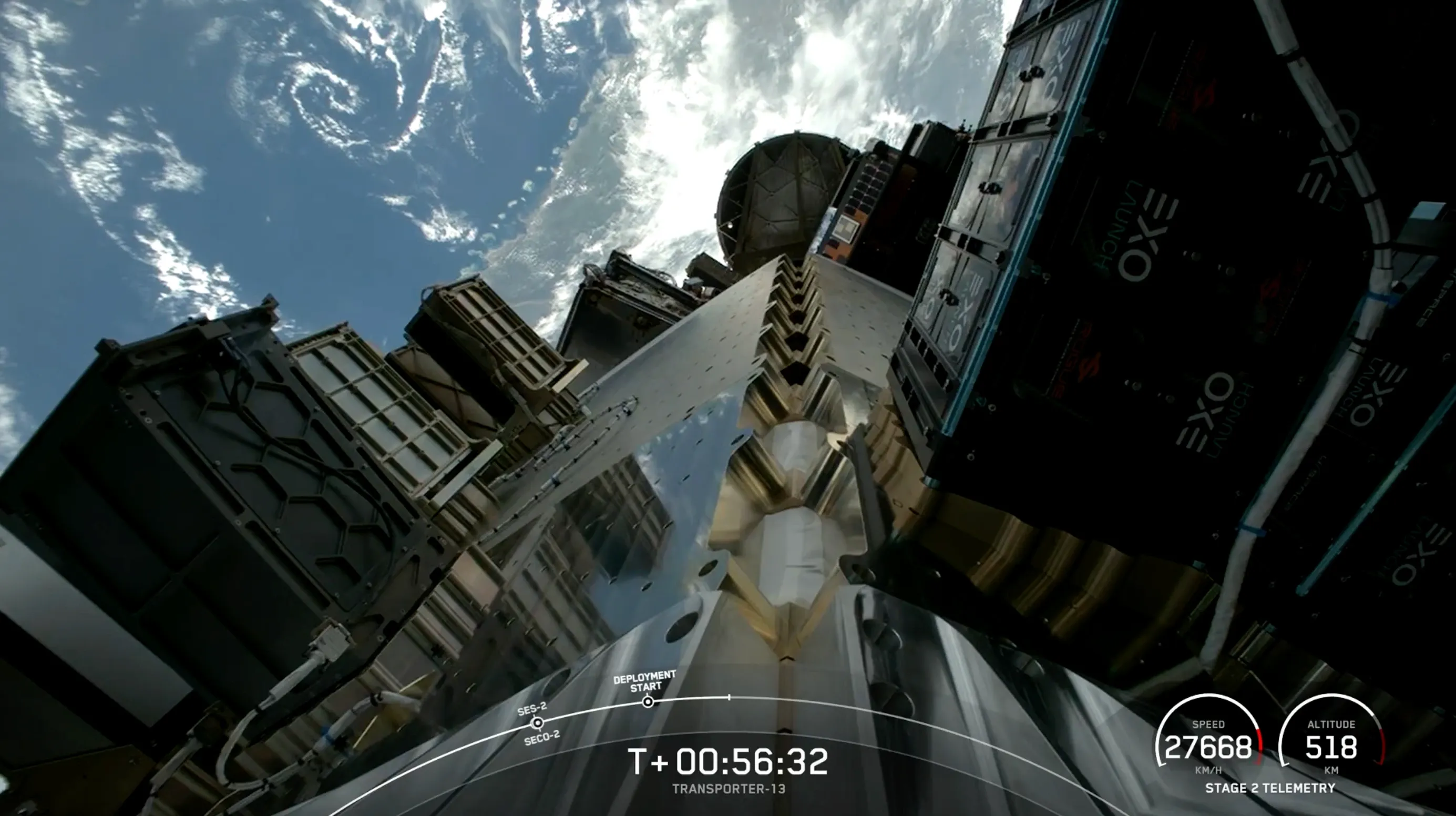 A view from Transporter-13 as AeroCube-18A and B, the satellites carrying the computer vision algorithm I worked on, are deployed.
I will never forget the emptiness I felt as I gazed up at Transporter-13 lighting up the night sky near Lompoc. I had for so long dreamt of working on a spacecraft. It's an achievement I'm very proud of—specifically after later seeing AeroCube-18 operate and my algorithm work—but I suppose in my mind I had built up the achievement so high that reaching it could never have satisfied the expectations I had set. It's a feeling I still have not come to terms with. My inner struggle is in whether I've not yet achived that "right" thing or if my dreams are foolish as Pippin's were.
GTRI was the first time I performed work squarely outside of aerospace. No longer was I making satellite algorithms or working on embedded flight software, nor was I taking classes in spacecraft navigation systems or planetary remote sensing. While I do utilize astrodynamics regularly, it's for the application of ground based radars tracking spacecraft. It was jarring and I found that I disliked the change.
Paradoxically, I found an increased joy in the work I was doing—the field of target tracking is fascinating and the math that makes it work is broad and complex. I've felt myself grow far more competent and detailed in mathematics than I ever was in school; incorrect results here means failed defense systems, not mediocre grades. From this work, I'm preparing a conference paper and a journal paper. The idea of publishing my work to the rest of the academic world is uniquely exciting and fills me with a pride I've never felt before. In all of this, I'm mentored by incredibly competent and caring researchers in the field that have taken me under their wings. Working here has made me significantly more competent as a researcher and I value that immensely.
It was this experience that caused me to rethink working at Lockheed. My two great loves in my career clashed and what was previously my dream job would have significantly curtailed my freedom as a researcher. No longer would I be sent to classes, publish in conferences, and review journals. I was informed that technical information would simply be taught to me by a superior. I could only conclude my growth would have been stunted significantly by chasing the dream of building spacecraft and I could not accept that. In my mind, it feels parallel to Pippin stepping back from the brink of self-immolation and choosing his family with Catherine. A dramatic parallel to say the least :P
I still have grand goals of working on space missions—expanding the horizon of human knowledge and capability. The euphoria I felt working in that realm is something that has been unmatched by anything in my life, though I fear the emptiness I experienced watching Transporter-13 might always be present. I think I'd rather know than wonder. Thus, to some extent, my inner delusion still speaks to me just as the Player spoke to Pippin. However, I now realize I have more priorities than just that—a realization that has brought me a lot more contentment than I previously had. At some point, I'll need to sort out how to reconcile these goals. But, for the time being, I'll stay where I am. I should be starting my PhD soon and surely have much to learn and do here. For now, much like Pippin, I'm trapped...but happy.
So I planned, and I schemed; 'Cause regrets are unanswered dreams.